


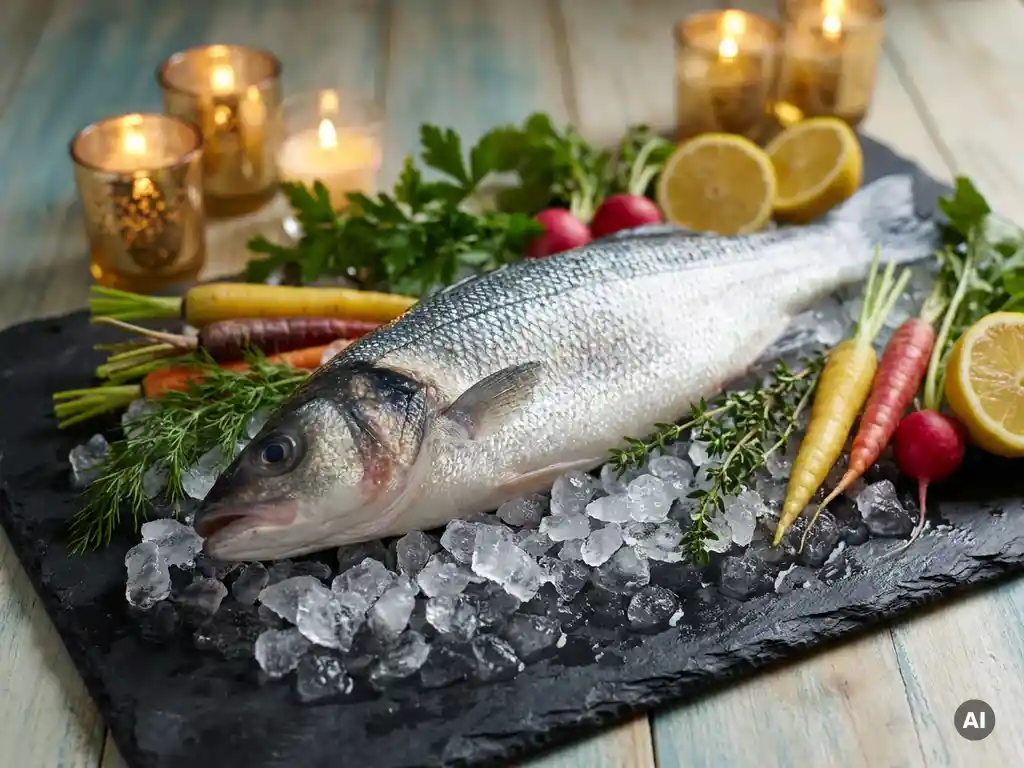
A seasonal menu at a fish restaurant in Amsterdam works on a simple principle: the offering changes with what nature has to provide at any given time. Which fish are available depends on the fishing seasons in Dutch and European waters, the quality of the season, and what can be caught responsibly. On our restaurant page you can read how we have been putting that philosophy into practice for over 25 years. In this article, we answer the most frequently asked questions about seasonal fish menus, so you know exactly what to expect.
Which fish are available per season in the Netherlands?
In the Netherlands, the fish offering varies considerably by season, because fish spawn, migrate, and grow at fixed times of year. In spring, young herring and sea bass are at their best. Summer brings langoustines, mackerel, and monkfish. In autumn, sole, turbot, and scallops take center stage, while winter is the prime season for oysters, lobster, and mussels.
Alongside sea fish, shellfish and crustaceans also play a major role in the Dutch seasonal offering. Oysters are traditionally eaten in months containing the letter “r” — that is, from September through April — because that is when they are most flavorful. Lobster is available year-round but reaches its peak during the summer months. Fruits de mer, a classic combination of fresh shellfish and crustaceans, is therefore a dish that truly comes into its own when several of its components are at their peak simultaneously.
Seasonal fish is not only tastier but also more sustainable. By choosing fish that is abundantly available at that moment, you reduce pressure on vulnerable stocks and support responsible fishing practices.
How often does a seasonal menu change at a fish restaurant?
At a serious seasonal fish restaurant, the menu changes at least four times a year, but in practice it changes far more often. Some dishes are updated monthly or even weekly, depending on what the daily catch brings in. The more frequently a menu changes, the stronger the connection to the seasons and the current availability of produce.
There are roughly two levels of menu change to distinguish:
- Seasonal change (four times a year): The broad outlines of the menu change. Different fish, different preparations, different side dishes that suit the time of year.
- Monthly or weekly change: Specific dishes are adjusted based on what the fish market delivers that week. This is the level at which truly fresh cooking becomes visible on the plate.
A chef’s menu that changes monthly, as is common at many quality fish restaurants, gives the kitchen team the freedom to be creative with what the season offers. Guests who return regularly will discover something new every time.
What is the difference between à la carte and a seasonal menu?
With à la carte, you choose which dishes to combine from a fixed menu. A seasonal menu is a curated multi-course menu in which the chef determines the sequence and combination of dishes, based on what the season has to offer at that moment. The key difference lies in who is in control: with à la carte, that is you; with a seasonal menu, that is the chef.
Both options have their own appeal:
- À la carte gives you freedom. You choose exactly what you want, in the order that suits you. Ideal if you have a specific dish in mind or if fellow diners have different preferences.
- Seasonal menu offers a complete experience. The chef builds a narrative from course to course, with flavors carefully matched to one another. An optional wine pairing is often available to enhance that story.
For guests looking for a special dining occasion — such as a birthday or a romantic dinner — a multi-course menu generally provides the most memorable experience. For a business lunch or a casual dinner, à la carte is often more practical.
Why does fish taste better in season?
Fish caught in season tastes better because the animal is in optimal condition at that time. Fish caught just before or after their spawning period are at their fattiest and most flavorful. Out of season, fish is often leaner, less aromatic, and the flesh has a different texture.
Freshness plays an equally important role. Seasonal fish needs to travel less far or be stored for less time, because it is available locally and in large quantities. That shorter journey from sea to plate is immediately noticeable in flavor and texture. A sole caught in the morning and served that evening tastes fundamentally different from one that has been in transit for days.
In addition, seasonal fish has a positive effect on value for money. When a species is abundantly available, purchasing prices are lower, which enables a restaurant to offer better quality at a fair price.
How do you choose the right dish from a seasonal menu?
You choose the right dish from a seasonal menu by paying attention to three things: your own taste preferences, the recommendation of the service staff, and the special or limited-time dishes on the menu. Dishes described as “exclusive” or “of the season” are almost always the best choice, as they reflect the peak of what is on offer.
A few practical guidelines to help you along:
- Ask for the dish of the day. Good fish restaurants work with daily deliveries. The service staff know which fish is the freshest and most special that day.
- Look out for temporary or exclusive dishes. A dish that appears on the menu for only a few weeks a year is worth trying. You will not always get the chance again.
- Match your choice to the season. In winter, a richer preparation with oysters or lobster is fitting. In summer, a lighter, fresher approach with sea bass or mackerel suits the moment.
- Consider the wine pairing. If the restaurant offers a multi-course menu with matching wines, this is an excellent way to complete the tasting experience without having to make the choice yourself.
Torn between two options? Do not hesitate to ask for advice. A good fish restaurant has staff who can guide you through your choice with enthusiasm and expertise.
How Visaandeschelde works with a seasonal menu
We put the principles of seasonal cooking into practice every day. At our restaurant in Amsterdam South, we work exclusively with daily-fresh fish and produce that is at its very best at any given moment. You will see that reflected in everything we offer:
- A monthly rotating Chef’s Menu, composed by our kitchen team based on the current seasonal offering
- The à la carte showpiece Vis Exclusief, an ever-changing dish that puts the finest catch of the moment in the spotlight
- Fresh fruits de mer and an extensive selection of oysters and lobster, tailored to the season
- An optional wine pairing with the multi-course menu, for a complete tasting experience
- Dishes for vegetarians and meat lovers, so everyone at the table finds something to their taste
Curious about what is on the menu this month? View our current menu and reserve in time — a table with us fills up quickly.
Veelgestelde vragen
Can I still dine at a seasonal fish restaurant if I am allergic to certain types of fish?
Yes, absolutely. A good fish restaurant accommodates allergies and dietary requirements, even with a multi-course menu. Always inform the restaurant of your allergy when making your reservation, so the kitchen team can take it into account and prepare an alternative if needed. Do not wait until you are seated, as adjusting a curated seasonal menu sometimes requires a little more preparation.
How far in advance should I make a reservation at a popular fish restaurant in Amsterdam?
For a weekday evening, booking two to three days ahead is generally sufficient, but for weekends and public holidays it is safer to plan one to two weeks in advance. Around special occasions such as Christmas, New Year’s Eve, or Valentine’s Day, popular fish restaurants in Amsterdam can fill up weeks ahead of time. Book early, especially if you have a specific date in mind for a special occasion.
Is seasonal fish always more expensive than fish available year-round?
Not necessarily. When a species is fully in season, purchasing prices are often lower because supply is plentiful. This makes it possible for a restaurant to offer top quality at a fair price. Fish offered out of season is often more expensive and less fresh, as it has to travel further or has been stored for longer.
What if I want a dish that is not on the current seasonal menu?
At a truly seasonal restaurant, there is a good chance that a dish is simply unavailable because the fish required is not at its best at that time. That is actually a sign of quality, not limitation. Feel free to ask the service staff what has come in particularly fresh that day — you will almost certainly be pleasantly surprised by an alternative you would never have discovered otherwise.
How do I know whether a fish restaurant genuinely works seasonally and is not just using it as a marketing term?
A reliable indicator is how often the menu changes: a restaurant that truly works seasonally updates its menu at least monthly and offers daily recommendations based on what has come in. When you arrive, feel free to ask about the origin of the fish or which catch arrived fresh that day. A transparent and enthusiastic answer from the staff is a strong sign that the seasonal philosophy is genuinely being applied in practice.
Are there seasons when a fish restaurant is less interesting to visit?
No, every season has its own highlights. Winter may seem like a quiet period, but it is precisely the season for oysters, lobster, and mussels at their finest. That is exactly the art of a good seasonal fish restaurant: giving each time of year its own moment to shine. When the menu moves in step with nature, there is always a reason to visit.
Can I combine a multi-course menu with à la carte dishes for other guests at the table?
That depends on the restaurant, but many fish restaurants offer both options side by side so that a table with mixed preferences can still dine together. It is a good idea to check this when making your reservation. That way, the kitchen team knows how to coordinate the timing of the courses so that everyone at the table can enjoy their meal at the same time.