


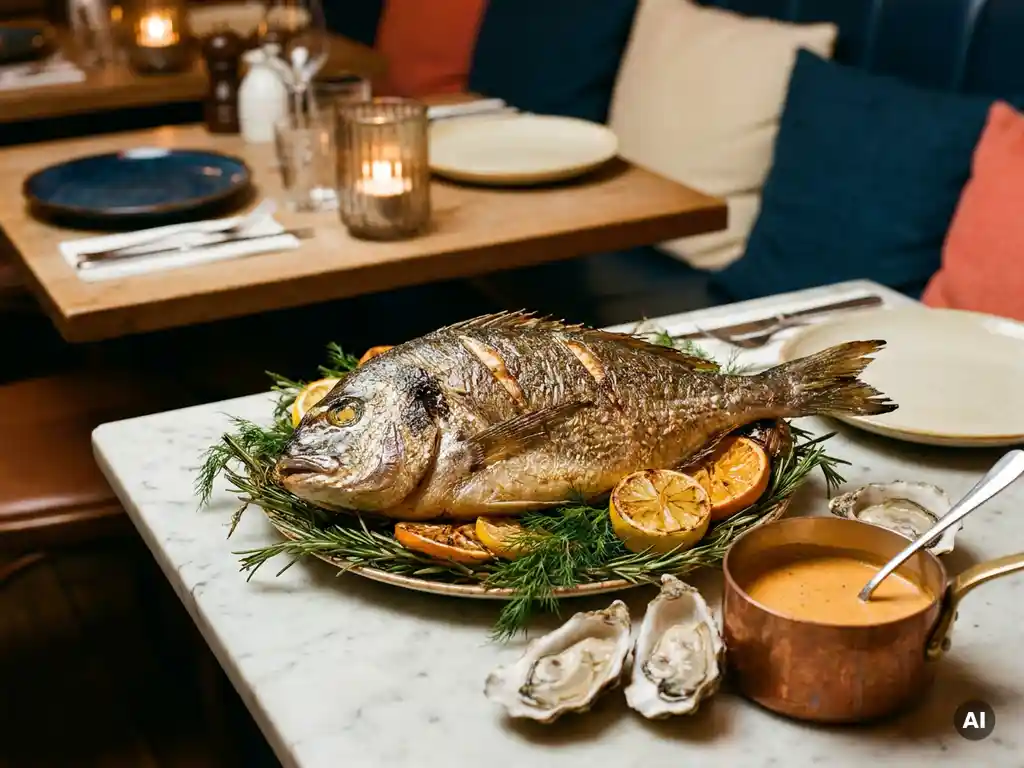
A true fish restaurant in Amsterdam does more than place fish on a plate. It gets the most out of what the season has to offer, works with products that arrive fresh daily, and builds a menu that moves with nature. If you’re looking for dishes you won’t find anywhere else, it’s precisely those seasonal specialties that make the difference. In this article, we highlight seven dishes you’ll only find at a fish restaurant that takes its craft seriously. Want to learn more about the philosophy behind this approach first? Read our story.
What sets a top fish restaurant in Amsterdam apart
Not every restaurant that serves fish deserves the label of fish restaurant. A truly exceptional establishment is defined by a daily supply of fresh products, a kitchen that follows the seasons, and a team that knows how to get the best out of every ingredient. In Amsterdam, very few restaurants consistently deliver on this. The dishes below are proof of that: they only appear on the menu when the quality is high enough, and disappear again once the season is over.
1: Wild sea bass with seasonal vegetables
Wild sea bass is one of the most versatile fish a kitchen has at its disposal. The flesh is firm, delicate in flavor, and lends itself beautifully to high-heat cooking, resulting in crispy skin while the flesh inside stays tender and juicy.
What sets this dish apart at a top fish restaurant is the pairing with vegetables that are at their peak at the same time of year. Think asparagus in spring or roasted pumpkin in autumn. That harmony between fish and vegetables is no coincidence — it’s a deliberate choice that elevates the dish as a whole.
Wild sea bass is the ideal dish for guests who are experiencing seasonal fish dishes for the first time. The flavor is approachable, the presentation elegant, and the combination with vegetables makes it a complete meal.
2: Fresh oysters straight from the water
Oysters are perhaps the most direct proof of freshness. An oyster that has spent too long in transit loses its briny freshness — and with it, its character. At a serious fish restaurant, oysters arrive as fresh as possible, ideally from suppliers with whom a direct relationship exists.
The way oysters are served says a great deal about a restaurant. Served simply on ice, with a squeeze of lemon juice or a light mignonette, the oyster is allowed to speak for itself. That demands quality that needs no disguising.
Oysters are perfectly suited as the opener of a multi-course menu or as part of a fruits de mer platter. They pair beautifully with a glass of chilled white wine or champagne and set the tone for an evening full of flavor.
3: Lobster prepared the classic way
Lobster is one of the most iconic products in the world of fish restaurants. Its preparation demands precision: too little time and the meat turns rubbery, too much and it loses its delicate texture. The classic approach — with butter, herbs, and perfect cooking — is a technique that requires years of experience.
A great fish restaurant doesn’t serve lobster as a showpiece, but as a dish that puts the quality of the product front and center. The sauce or accompaniment is supportive, never dominant. It’s all about the lobster itself.
Lobster is the perfect choice for a special occasion. Whether it’s a birthday, a romantic dinner, or a business evening, lobster adds a celebratory character to any meal.
4: Vis Exclusief — the rotating showstopper
Few dishes on a menu reveal as much about a restaurant as a rotating showstopper that depends entirely on what the day brings. Vis Exclusief is exactly that: a dish without a fixed identity, but with a steadfast promise of quality and surprise.
The fish that is at its best on any given day determines what ends up on the plate. That could be a rare catch, an unusual preparation, or a combination the chef devised that morning based on what was available. It’s precisely that unpredictability that makes it appealing to guests who want to experience a kitchen at its very best.
Vis Exclusief appeals to guests who are happy to leave their choice in the hands of the kitchen’s expertise. It’s also a reason to come back more often, because the dish is never the same twice.
5: Turbot with beurre blanc in winter
Turbot is one of the most prized flatfish in European cuisine. The flesh is white, firm, and rich in flavor, with a fat content that makes it ideally suited to oven or grill preparation. In winter, when the fish is at its best, turbot is a natural choice for a warm and satisfying main course.
The pairing with beurre blanc — a classic butter sauce made with white wine and shallots — is one of the most successful combinations in French fish cookery. The rich sauce contrasts with the firm texture of the fish while simultaneously enhancing its delicate flavor.
Turbot with beurre blanc is a dish for guests who appreciate classic French-Belgian cuisine and aren’t afraid of a richer preparation on a cold winter’s evening.
6: Scallops in autumn
Scallops — or coquilles Saint-Jacques — are at their best in autumn and early winter. The season determines the quality: during this period, the shells are plump, sweet, and full of umami. A great fish restaurant waits for that moment and only puts them on the menu when the time is right.
The preparation is often kept simple: briefly seared in butter, with a golden-brown crust on the outside and a soft center. Accompaniments such as cauliflower purée, truffle sauce, or a light bisque enhance the flavor without overpowering it.
Scallops are ideal as a starter or intermediate course. They are elegant, not too heavy, and give a meal a refined tone that suits an evening out at a top fish restaurant in Amsterdam.
7: Mackerel — the underrated king of summer
Mackerel is underestimated in many restaurants, but at a serious fish restaurant this summer product is given the respect it deserves. The fish is oily, aromatic, and full of flavor, making it perfect for grilling or smoking. In summer, when mackerel is at its peak, it deserves a prominent place on the menu.
The bold flavor of mackerel calls for accompaniments that can hold their own: a fresh summer salad, a sharp mustard vinaigrette, or grilled vegetables. That combination of intensity and freshness makes mackerel a dish that surprises and convinces in equal measure.
Mackerel appeals to guests who dare to look beyond the familiar choices. It’s a dish for someone who wants to discover what a fish restaurant is truly capable of, off the beaten path.
How Visaandeschelde helps you taste the season
At Visaandeschelde, we build our entire menu around the seasons and the daily supply of fresh fish. Every dish we serve is a direct reflection of what is at its best at that moment. That’s not a marketing story — it’s the way we have worked for more than 25 years.
Here’s what you can expect from us:
- A seasonal menu that changes monthly, put together by our kitchen team
- Fresh fish and seasonal produce delivered daily as the foundation of every dish
- A choice between à la carte and a multi-course menu with optional wine pairing
- Dishes for fish lovers, as well as for vegetarians and meat lovers
- A welcoming brasserie in Amsterdam South, opposite the RAI convention center, with a terrace
Curious about what’s on the menu right now? View our current menu and reserve in time — our tables fill up quickly.
Veelgestelde vragen
How do I know which seasonal dishes are currently available at a fish restaurant in Amsterdam?
Most serious fish restaurants, including Visaandeschelde, update their menu regularly — sometimes even daily. The best way to stay up to date is to check the restaurant’s website or social media, or simply call ahead when making a reservation and ask what has come in fresh that day. A good fish restaurant is always happy to tell you more.
I'm not a big fish eater — are seasonal dishes at a fish restaurant still suitable for me?
Absolutely. Dishes like wild sea bass or scallops are particularly approachable in flavor and make an excellent entry point for anyone who isn’t used to bold fish flavors. In addition, many fish restaurants, such as Visaandeschelde, also offer dishes for vegetarians and meat lovers, so everyone at the table can find something they’ll enjoy.
What is the best time of year to visit a fish restaurant in Amsterdam for the most special seasonal specialties?
Every season has its own highlights: in spring there are asparagus and the first fresh oysters, in summer mackerel shines on the grill, in autumn scallops are at their best, and in winter turbot with beurre blanc is an absolute must. There really is no bad time to visit — every season offers its own unique flavor experiences.
How do I pair wine with seasonal fish dishes if I don't know much about wine?
A good rule of thumb is: lighter fish dishes such as oysters or sea bass pair well with a dry white wine like Chablis or Muscadet, while richer dishes such as turbot with beurre blanc or lobster also go beautifully with a full-bodied white Burgundy. When in doubt, feel free to ask the sommelier or the restaurant’s staff for advice — at a top fish restaurant, they’re always happy to help you make the right choice, even if you’re not very knowledgeable about wine.
Why isn't a dish like mackerel on the menu more often in restaurants, if it's so delicious?
Mackerel has long had a reputation as an ‘ordinary’ or ‘cheap’ fish, which led many restaurants to overlook it in favor of more popular varieties like salmon or tuna. Yet in summer, mackerel is an exceptional product: full of flavor, sustainably caught, and versatile in the kitchen. Fish restaurants that take their craft seriously deliberately put mackerel on the menu as proof that quality doesn’t always come with a high price tag.
Is it advisable to book in advance at a fish restaurant in Amsterdam, or can I just walk in?
At popular fish restaurants in Amsterdam — especially those with a seasonal menu — booking in advance is strongly recommended. Because the menu changes daily and the purchase of fresh fish is planned accordingly, many kitchens work with a limited number of covers per evening. By reserving ahead, the restaurant also has a better idea of how much of each dish needs to be prepared, which benefits the overall quality.
What makes a 'Vis Exclusief' dish different from the rest of the menu, and how do I know if it's right for me?
A Vis Exclusief dish is entirely dependent on what has the highest quality that day — it’s a direct reflection of the kitchen’s expertise and confidence. It’s ideal for guests who are open to surprise and happy to leave the choice to the chef. If you’re someone who usually orders the same thing, this is a great opportunity to discover something new that you might never have chosen otherwise.
Gerelateerde artikelen
- Welk zonnig terras is geschikt voor een verjaardag?
- Wat kost een diner bij een visrestaurant in Amsterdam gemiddeld?
- Wat zijn de beste visgerechten om te proberen in een restaurant in Amsterdam?
- Welk zonnig terras heeft vegetarische gerechten?
- Wat zijn de nieuwste fine dining restaurants in Amsterdam in 2026?