


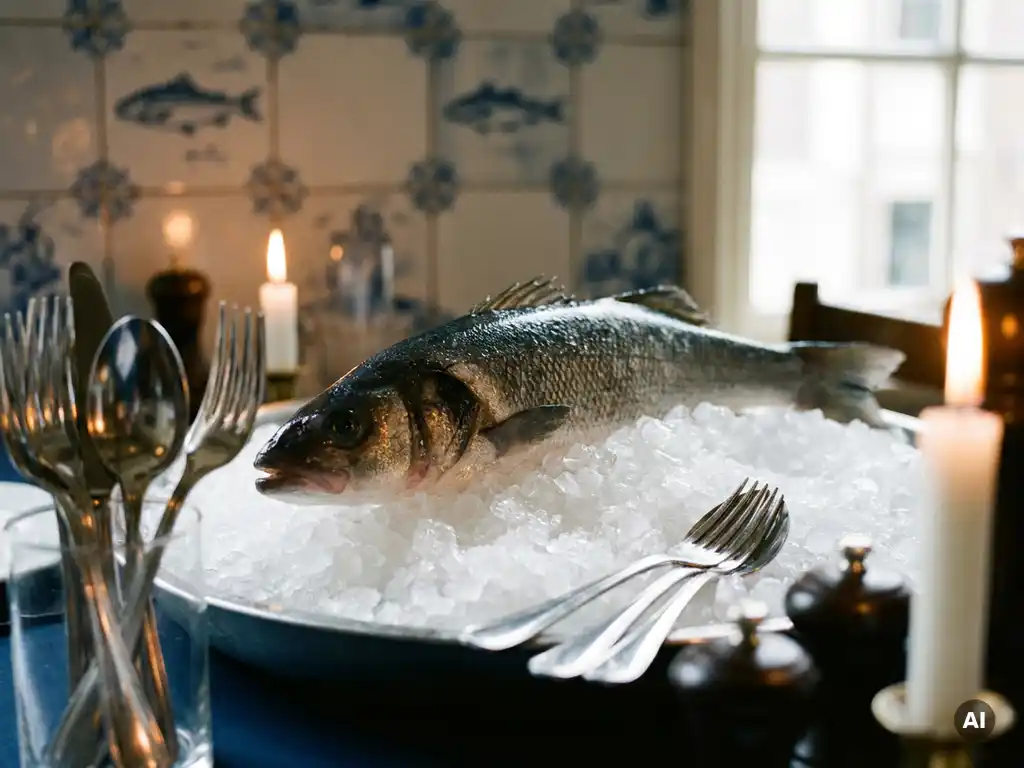
A fish restaurant in Amsterdam is a dining establishment that specializes in dishes based on fish, shellfish, and seafood, with a menu built around daily fresh catches and seasonal produce. Unlike a typical restaurant, the kitchen here revolves entirely around the sea — from oysters and lobster to grilled sole and marinated ceviche. In this article, we answer the most frequently asked questions about fish restaurants in Amsterdam, so you can arrive at the table fully prepared. Discover who we are and what drives us.
What sets a fish restaurant apart from a regular restaurant?
A fish restaurant distinguishes itself from a regular restaurant through a menu that is entirely or largely built around fish, shellfish, and seafood. Sourcing happens daily, the kitchen has specialized knowledge of preparation techniques such as poaching, steaming, and making ceviche, and the menu reflects what the sea and the seasons have to offer at any given moment.
Where a general restaurant treats fish as one of many options, in a fish restaurant it is the starting point for everything. The chef builds the menu around the day’s catch, not the other way around. This requires a different sourcing strategy, different expertise in the kitchen, and a different approach to hospitality. Guests who choose a fish restaurant do so deliberately: they seek depth, variety, and quality that you rarely find at a generalist restaurant when it comes to seafood.
What dishes are typically on the menu at a fish restaurant?
The menu at a fish restaurant typically features oysters, Fruits de Mer, grilled or pan-fried fish, ceviche, bisque, and seasonal specialties such as lobster. The menu varies by season and by day, depending on what is available fresh at the market.
A classic start to the meal often consists of oysters or a plateau de Fruits de Mer, followed by a fish soup or tartare as an intermediate course. For the main course, grilled sea bass, pan-fried sole, or a lobster preparation are popular choices. Many fish restaurants also offer a rotating daily special that depends entirely on the morning’s catch. This keeps the menu lively and gives regular guests something new to look forward to every time.
Good fish restaurants also offer alternatives for guests who do not eat fish. Vegetarian dishes and meat options ensure that mixed groups can dine comfortably without anyone feeling limited.
How can you tell if the fish at a restaurant is truly fresh?
You can recognize fresh fish at a restaurant by a few concrete signs: the menu changes regularly, the staff can tell you where the fish comes from and when it was caught, and the dishes smell and taste of the sea — not of stored product.
Fresh fish has a mild, clean scent. If you detect a fishy smell from the plate, that is a sign the fish is not at its best. Also look at the menu itself: a restaurant that sources fresh produce daily will have a menu that changes along with it. A fixed menu that never changes is more likely to indicate frozen or long-shelf-life products.
Feel free to ask the server when the fish arrived and where it came from. At a good fish restaurant, the staff will know the answer without hesitation. Transparency about provenance is a strong indicator of quality and trustworthiness.
What is the difference between à la carte and a multi-course menu at a fish restaurant?
With à la carte, you choose which dishes to order yourself, with no fixed sequence or set price per course. With a multi-course menu, the kitchen maps out a culinary journey for you, consisting of several courses that complement one another, often accompanied by an optional wine pairing.
À la carte offers maximum freedom: you set the pace, choose the combinations, and decide how much you order. This is ideal if you want to try a specific dish or if your group has varying preferences. The rotating daily special Vis Exclusief is a great example of an à la carte gem that changes daily based on the finest catch.
A multi-course menu offers a different experience: you let yourself be guided by the chef’s creativity. Each course builds on the previous one, the flavors are carefully balanced, and you discover combinations you might not have chosen yourself. For a special occasion or when you want to put your full trust in the kitchen, a multi-course menu is an excellent choice. View our current menu for a taste of what we offer.
Where in Amsterdam can you find the best fish restaurants?
The best fish restaurants in Amsterdam are spread across the city, but concentrations can be found in Amsterdam South, around the city center, and near the IJ waterfront. Amsterdam South is known for its refined dining culture and attracts restaurants that place a high value on quality.
The Rivierenbuurt neighborhood in Amsterdam South is a particularly appealing area for seafood lovers. The quiet streets, the atmospheric brasseries, and the proximity to the RAI convention center make this area popular with both Amsterdam locals and visitors from out of town. Restaurants in this neighborhood cater to guests who consciously choose quality and a complete dining experience.
Beyond location, reputation also matters. Restaurants that have existed for more than two decades in a competitive city like Amsterdam have earned that standing for good reason. Loyal regulars, word of mouth, and consistent quality are the best indicators that you are in the right place.
Should you make a reservation at a fish restaurant in Amsterdam?
Yes, at popular fish restaurants in Amsterdam, making a reservation is strongly recommended — especially on weekends, during public holidays, and in the summer months. Well-regarded fish restaurants with a loyal clientele are regularly fully booked, and without a reservation you risk missing out on a table.
Reserving also has practical advantages: you can communicate any dietary requirements or special occasions in advance, giving the restaurant time to prepare accordingly. Think of a birthday, a business dinner, or a romantic evening where you want everything to be just right. A good kitchen will accommodate such requests when the team is informed in time.
The earlier you reserve, the more choice you have in terms of time slot and table size. For a group of six or more, booking well in advance is essentially essential.
How Visaandeschelde completes your fish restaurant experience in Amsterdam
We have been a fixture in the Rivierenbuurt in Amsterdam South for over 25 years, and every day we commit ourselves to a fish restaurant experience that delivers from start to finish. Here is what you can expect from us:
- Fresh fish every day, sourced directly based on the finest catch of the day
- A seasonal menu that moves with what nature has to offer at any given time, including oysters, lobster, and the rotating daily special Vis Exclusief
- A choice between à la carte and a monthly rotating Chef’s menu, with an optional wine pairing curated by our kitchen team
- Dishes for everyone, including vegetarian options and choices for meat lovers
- An atmospheric maritime setting on Scheldeplein, opposite the RAI convention center, with a terrace for outdoor dining
Whether you come for a romantic dinner, a business lunch, or a festive outing with friends: we make sure every moment counts. Reserve your table via our reservations page and secure your seat at the table.
Veelgestelde vragen
How far in advance should I make a reservation at a fish restaurant in Amsterdam?
For a weekday evening, reserving two to three days ahead is usually sufficient, but for weekends, public holidays, or special occasions, we recommend booking at least one to two weeks in advance. At popular fish restaurants like Visaandeschelde, the best time slots and tables fill up quickly on weekends. If you have a large group or a special request, reserve as early as possible to avoid disappointment.
What is a good wine choice to pair with a fish or seafood menu?
White wines are classically the best match for fish and seafood: think a dry Chablis with oysters, a crisp Sauvignon Blanc with ceviche, or a full-bodied Bourgogne Blanc with grilled sea bass. Rosé and light, fruity red wines can also work well with heartier fish dishes such as tuna. Many fish restaurants offer a wine pairing with their multi-course menu, which is an excellent way to discover the right combinations without any guesswork.
Can I dine at a fish restaurant if I have a shellfish allergy?
Yes, but it is essential to mention this when making your reservation and again upon arrival when speaking with your server. A professional fish restaurant works with many ingredients that contain shellfish or may come into contact with them, but a skilled kitchen team can accommodate this if they are informed in time. Always ask explicitly about cross-contamination, as in a kitchen that works daily with oysters, lobster, and shrimp, this is a genuine concern.
What is the difference between seasonal fish and fish that is available year-round?
Seasonal fish is caught at the time when the species is at its most flavorful and sustainable, which noticeably benefits both taste and texture. Flatfish such as sole and turbot, for example, are at their best in spring and summer, while oysters are traditionally most full-flavored during the winter months. Fish that appears on a menu year-round is often frozen or farmed, which is not necessarily bad, but does offer a different eating and tasting experience compared to a fresh, seasonal product.
How can I recognize a fish restaurant that truly sources sustainably?
A sustainable fish restaurant is transparent about the origin of its products and preferably works with MSC-certified fish or local suppliers with demonstrably responsible fishing practices. The menu contains few or no endangered species such as wild Atlantic salmon or bluefin tuna, and the staff can tell you where the fish comes from. Certification labels on the menu and an actively seasonal offering are also strong signals that a restaurant is mindful of the sea and its future.
Is a fish restaurant suitable for children, or is it more of an adults-only venue?
Most fish restaurants are perfectly suitable for children, especially if the restaurant also offers vegetarian or meat-based alternatives for guests who do not eat fish. Children who do enjoy fish can be introduced to new flavors in an accessible setting. It is a good idea to mention when making your reservation that you are bringing children, so the restaurant can arrange an appropriate table layout and possibly point out a child-friendly option on the menu.
What are common mistakes when ordering at a fish restaurant?
A common mistake is overlooking the daily special or the rotating seasonal offering, when that is precisely the freshest highlight of the day. Guests also sometimes over-order without accounting for the richness of a fish or seafood menu, which is naturally more filling and substantial than it may appear. Finally, we always recommend asking your server for advice: at a good fish restaurant, the team knows the menu inside and out and can guide you to the best dish of the moment based on your personal taste preferences.
Gerelateerde artikelen
- 11 dingen die een goed visrestaurant in Amsterdam onderscheidt
- Wanneer is het beste seizoen om een visrestaurant in Amsterdam te bezoeken?
- Waar vind je een culinair zonnig terras?
- Wat is de beste wijk in Amsterdam voor fine dining?
- Welke fine dining restaurants in Amsterdam hebben uitzicht over de grachten?